What if golf isn’t a sport at all? What if great golf, golf performance at the highest-level, has a completely different nature altogether?
Buckle in, because we’re about to go on a trippy ride.
During the winter months, Ohio golfers have plenty of time to prepare for the upcoming season. We can think of new ways to improve our scores and lower our handicaps. We can plan on bettering our body with stretching and training. We can look toward buying new equipment, dialing in specs with a club fitting, or experimenting with a new ball.
But what if all those thoughts fall far behind another way to make outsized gains in golf performance?
The idea I’m about to present isn’t directed toward players who haven’t mastered the basics. The 10,000 hours concept — that it takes 10,000 hours of learning and practice to master any skill — is real. If you can’t hit a 100-yard wedge shot mostly where you’re looking, you need more mastery before you can consider and apply what I’m about to lay down.
But for those who have mastered the basics and have a moderately-functioning body with a proper bag of equipment: what if going low time-after-time isn’t about spending more time on the practice tee or buying the latest gear? What if the skill that’s actually missing from your game is mentally bending physical reality?
A few days ago, the PGA TOUR put out a compilation video of the career top-50 shots of Tiger Woods. If you haven’t seen it yet, it’s mind-boggling. Hole-outs from everywhere, magical escapes from trouble you can’t make up, shots shaped in every direction and trajectory that finish near or even in the hole. Check it out:
And those 50 shots are only from PGA TOUR events! They don’t include shots played at the four major championships, where Tiger has undoubtedly made hundreds more that are equally spectacular, but under the added stress of history-in-the-making and brutally difficult course setups.
Now granted, Tiger Woods has generational physical talents, a lifetime of practice and competitive reps, and a tour-only level of equipment that an amateur can only dream about. But a couple thousand other tour professionals have talent and practice and the latest gear, too. Yet those players couldn’t generate anything close to the highlight reel the PGA TOUR put together for Tiger.
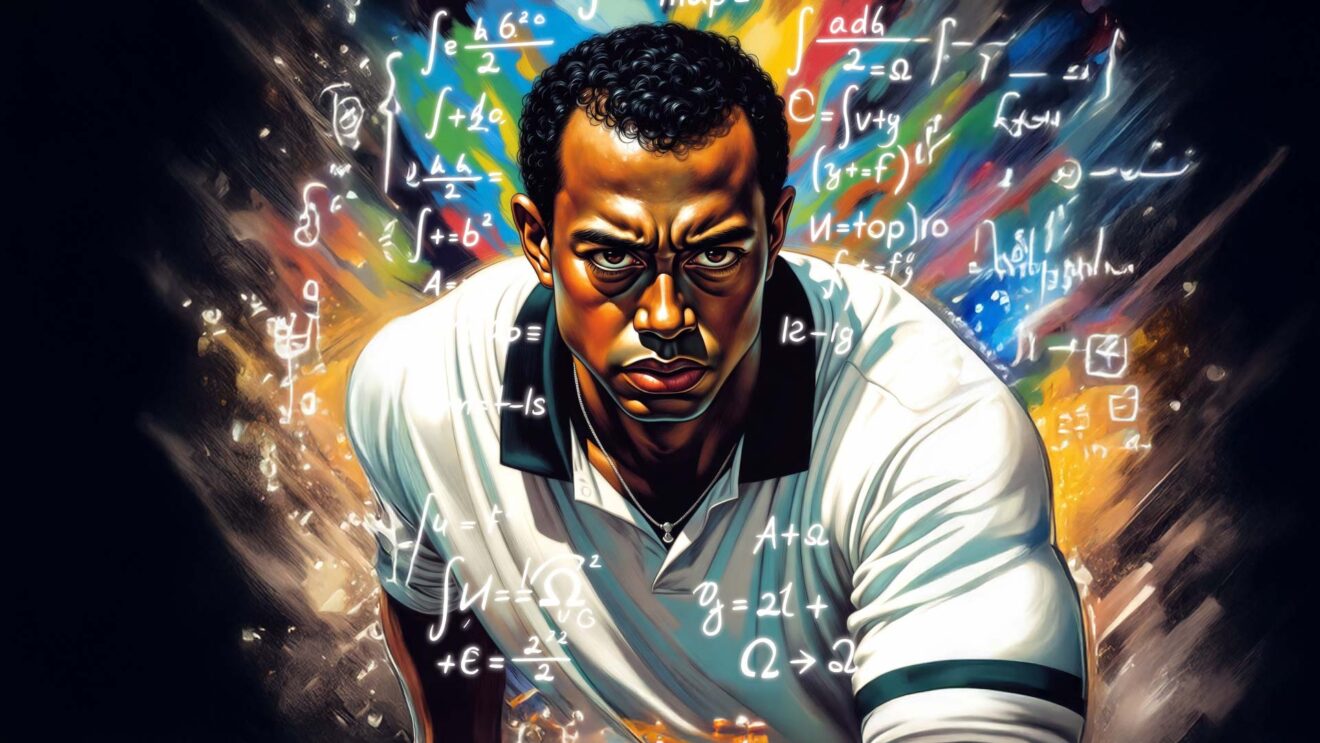
So – hear me out – what if the skill that separates Tiger from the rest of the pro game is a quantum ability to bend physical reality with his mind?
Sometimes, people call this state of mind “the zone.” Even mid-handicappers can fall into the zone on occasion. It’s where a player is calm and focused enough to approach a shot, visualize a successful outcome, then execute that outcome without a thought as to how it is done. The inside-the-head conversation goes quiet and the body simply takes over to make the proper stroke.
The zone is the greatest feeling in golf. In fact, I’d argue that it IS the game of golf. Feeling the zone for even one shot during a round is the reason true golfers play the game.
But “the zone” is just the starting point for what I’m talking about. I’m suggesting a 10x version of the zone, delving into the realm of ‘bending spoons with your thoughts’.
Let’s talk about psychokinesis.
A physicist named Hal Puthoff has publicly told the story many times about his pioneering work at the Stanford Research Institute (SRI). He even wrote a book on it after the CIA declassified his decades-long program. More recently, he appeared on Joe Rogan’s podcast last spring.
Puthoff, initially a laser physicist, grew curious about consciousness and energies. He had a shielded experiment running at SRI: a highly protected magnetometer, a sensitive quantum device, located inside multiple layers of electrical, magnetic, and superconducting shielding, with acoustic isolation. The experiment was designed to measure tiny field disturbances with no external influences.
After hearing him speak at a conference, self-proclaimed psychic Ingo Swann contacted Puthoff about his interest in consciousness. Swann first visited Puthoff at his lab on June 6, 1972. While there, Swann told Puthoff that he could “remote view” his deeply-buried experimental device, which no one had described to him. He sat quietly for a short period of time, then accurately sketched the experiment’s internal structure and components, shocking the graduate students observing the session. But then even more shocking to Puthoff, Swann then claimed he could influence the results of the shielded experiment mentally!
Swann focused his mind on the device and reportedly disrupted its normal oscillations, doubling the frequency or causing a noticeable spikes in the magnetic field readout for several seconds. The equipment recorded the anomalies, which Puthoff described as impossible under normal physics.
Puthoff was skeptical but couldn’t explain Swann’s disruptions. His theory on the results were that Swann had combined remote viewing (accurately perceiving the hidden internals) with psychokinesis (mind influencing matter, altering the device’s output).
After additional experiments with Swann, Puthoff expanded their remote viewing research into a structured program at SRI.
The key breakthrough in the program was realizing that remote viewing wasn’t limited to gifted psychics like Swann. Puthoff and Swann collaborated to develop a training protocol, called Controlled Remote Viewing or CRV, designed so that nearly anyone could learn it with proper instruction.
Early CRV experiments included training non-psychic participants, including scientists and volunteers, showing that ordinary people could achieve results with practice. Their protocol shifted CRV from relying on natural talents to turning the process into a teachable skill.
By the mid 1970s, the CRV program transitioned to full CIA and military oversight. Puthoff and his team directly trained U.S. Army intelligence officers. Skeptical personnel were sent to SRI, where they underwent the CRV training. Many, including notable viewers like Joe McMoneagle, improved so significantly that they produced operationally useful results like describing hidden Soviet facilities that were later verified on the ground.
So here’s my wildly speculative theory: what if Earl Woods, who was a lieutenant colonel in the U.S. Army and lived in Southern California in the early 1970s, was one of the classified military subjects who learned CRV? What if he transferred the baseline knowledge of CRV to his son, Tiger, who not only learned remote viewing, but also had enough God-given mental talent like Ingo Swann to make “the zone” his own?
Even further, what if Tiger’s next step in “the zone” was to be being able to make a golf ball react exactly as he envisioned, aided by psychokinetic forces from his mind? What if he could physically “will the ball into the hole” like so many TV announcers like to say?
It’s certainly one way to explain the absurdity of that top-50 shots video!
So let’s bring all of this psychobabble back to your game. How can you, as a mere mortal golfer without access to a classified CIA program (lol), transfer the ideas of CRV and psychokinesis to your own preseason preparation?
Well, many books specifically written for golf discuss training your mind to reach “the zone”:
• Zen Golf: Mastering the Mental Game by Dr. Joseph Parent
• Golf Flow: The Mental Game Plan for Peak Performance by Dr. Gio Valiante
• The Inner Game of Golf by W. Timothy Gallwey
• Finding Your Zone: Ten Steps to Enhancing Your Peak Performance by Dr. Michael Lardon
• Play Golf in the Zone: The Psychology of Golf Made Easy by Garry Martin and Derek Ingram
• Zone Golf: Master Your Mental Game Using Self-Hypnosis by Kelly Sullivan Walden
Read and research the topic of the zone on your own. Then over the next few cold winter months, train your mind to “see” well executed shots as you hit practice balls at your favorite indoor facility.
Learn to lock-on and stay locked-on to a target within your mind’s eye.
Clearly visualize shots around and on the green going into the hole before you play them.
Overcome the internal discussions that chatter on relentlessly in your head, and figure out a trigger to calm your thoughts and stop the self-talk.
Then commit to doing your absolute best during each round of the 2026 golf season to play every shot like you are bending spoons with your mind.